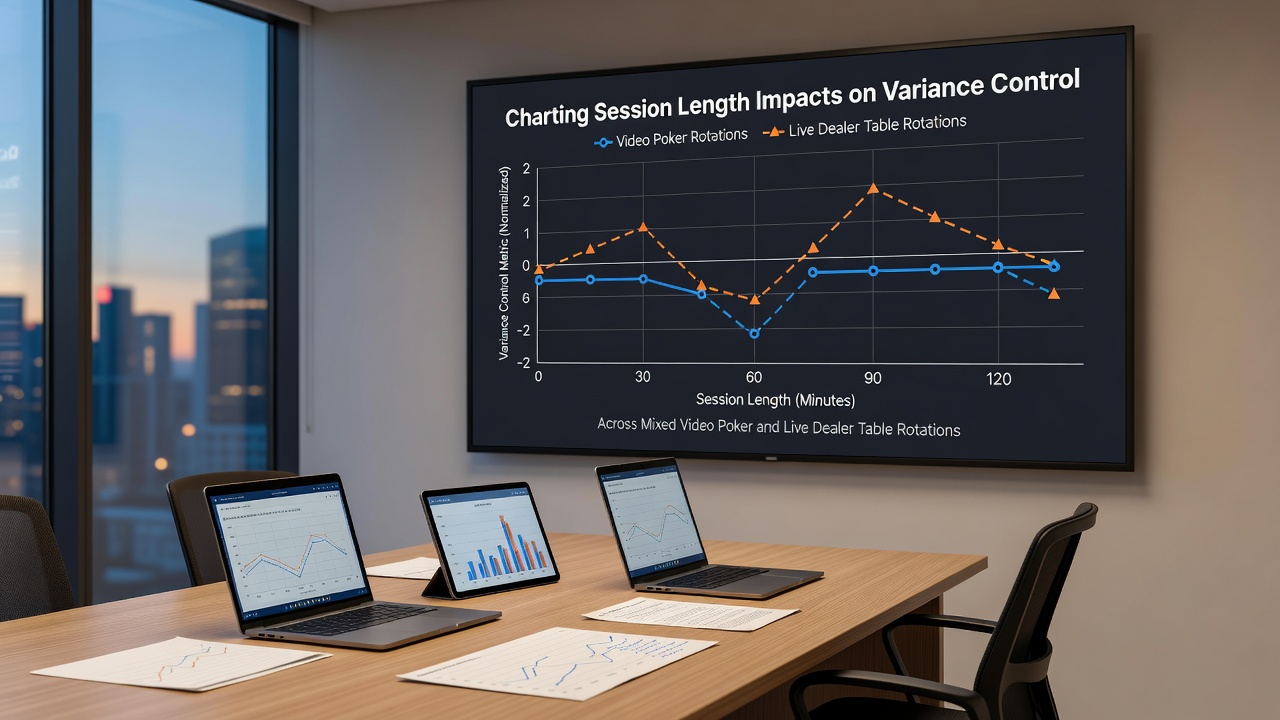
Examining Session Length Effects on Variance Management in Video Poker and Live Dealer Combinations
Session length tracking provides a measurable framework for managing variance when players alternate between video poker machines and live dealer table games, and researchers have documented how duration directly shapes outcome distribution in these mixed formats. Data from multiple jurisdictions indicates that shorter sessions tend to amplify the impact of individual hand or round results, whereas extended play periods allow statistical averaging to take effect across different game types.
Defining Variance in Mixed Gaming Environments
Video poker carries a lower inherent variance than many table games when played with optimal strategy, yet live dealer rotations introduce higher fluctuation through elements such as dealer shuffle randomness and multi-player bet dynamics. Observers note that combining these formats creates a composite variance profile where session duration becomes the primary control variable, and studies from the Nevada Gaming Control Board have quantified how standard deviation narrows as total hands and rounds increase beyond certain thresholds.
Those who track play sessions consistently report that variance spikes occur most sharply in the first 30 to 60 minutes of any rotation, regardless of whether the player begins on video poker or moves to a live blackjack table. This pattern holds because early outcomes carry disproportionate weight before the law of large numbers begins smoothing results across the mixed portfolio.
Session Duration Data and Rotation Patterns
Analyses of player behavior across North American and Australian markets reveal distinct clusters where sessions under 90 minutes exhibit wider result spreads compared with those extending past three hours. One study released in November 2026 by the Victorian Commission for Gambling and Liquor Regulation tracked over 12,000 mixed sessions and found that participants who maintained consistent rotation intervals of 25 to 40 minutes between video poker and table games achieved narrower variance bands than those who switched at irregular intervals.

Experts have observed that charting these intervals allows players to identify personal inflection points where variance begins to stabilize, and the same Victorian data set showed measurable compression in outcome ranges once cumulative play exceeded 200 hands or rounds in a single continuous session. The compression effect proved more pronounced when video poker segments preceded table play rather than the reverse order.
Practical Charting Methods for Variance Tracking
Participants who log start times, game switches, and cumulative results can map how session length modulates the standard deviation of their returns, and several industry reports confirm that digital tracking tools reduce human error in these records. According to figures from the Nevada Gaming Control Board, video poker machines in optimal-play configurations post a standard deviation approximately 40 percent lower than live dealer blackjack over equivalent hand counts, yet this advantage erodes when session length remains below the two-hour mark because table game swings dominate the overall distribution.
Those who've studied rotation sequences point out that inserting brief video poker segments between table rounds can dampen variance spikes without extending total session time, and the effect scales linearly with documented session length up to approximately four hours. Beyond that point, additional duration yields diminishing returns on variance reduction while increasing exposure to other operational factors such as table minimum changes or machine pay table resets.
Comparative Outcomes Across Session Length Brackets
Breakdowns by duration bracket show clear separation in result dispersion, with sessions of one hour or less producing the widest ranges and those between two and four hours delivering the tightest clustering around expected value. Research indicates that players alternating formats every 35 minutes on average maintain lower peak-to-trough swings than those who complete full 90-minute blocks on a single game type before rotating, and this holds across both video poker and live dealer environments.
Geographic comparisons further illustrate the pattern, with Canadian provincial data aligning closely with Nevada findings on the relationship between cumulative hands and variance contraction. The consistency across regions suggests the underlying mathematics of mixed-game variance responds primarily to session length rather than regulatory or venue-specific variables.
Conclusion
Charting session length therefore functions as a direct lever for variance control when video poker and live dealer tables are combined, and available data supports structured duration management as an effective approach. Continued collection of rotation-specific metrics across additional markets will refine these relationships as participation patterns evolve through November 2026 and beyond.